Skip to content

When picking out bedroom essentials, the huge price range of down comforters often leaves people tangled. Why can some be bought for just $200 while others cost as much as $2,000, even though they all claim to keep you warm? Is it just overpriced brand markup, or is there a world of difference in materials and craftsmanship? If we look past the marketing hype of “Alpine goose down” and “900+ fill power”, we’ll find the core of this price gap lies in a few key factors. And in the value-for-money segment, APSMILE down comforters—backed by 36 years of professional manufacturing experience serving global hotels—deliver above-grade quality at a wallet-friendly price. Just ask Sarah from Chicago, who swapped her $1,200 designer comforter for APSMILE and said, “I can’t tell the warmth difference, but my wallet sure can.”

The Core of the Price Gap: A 5-Tier Hierarchy from Down Clusters to Craftsmanship
A $2,000 down comforter is by no means a waste of money, but a $200 one isn’t necessarily a dud either. The gap between them boils down to incremental upgrades across every aspect, from core filling to detailed craftsmanship—not a simple difference in quality on a single level.

Tier 1: Filling—The “Genetic Code” of Warmth
The true value of a down comforter starts with its filling. The divide between goose down and duck down is the first line of the price gap. The industry saying—“Ignore duck down under $1,000; ignore goose down under $2,000”—may be an overgeneralization, but it points to the basic value of materials: goose down clusters are larger and loftier, offering far better warmth-to-weight ratio than duck down of the same grade, meaning it keeps you warmer without the bulk.
$2,000 comforters usually use white goose down from high-latitude regions like Hungary and Canada, with a cluster integrity rate of over 95%. On the other hand, regular $200 comforters mostly use duck down—or even a mix with plenty of feathers—resulting in much lower warmth and loft.
But upgrading materials isn’t just about “goose down being better than duck down”. Top-tier eiderdown, with a fill power (FP) of only 700–800 (lower than the 800–950 of high-end goose down), forms a stable warmth-retaining network thanks to its natural oils and hook-like structure. It’s warmer without any unpleasant odors at the same thickness, positioning it like vicuña wool in the cashmere family. However, this premium material is usually reserved for luxury lines priced above $3,000; the $2,000 range still mainly features high-grade goose down.
Tier 2: Fill Power & Fill Weight—The “Dual Engines” of Warmth
What determines a comforter’s warmth efficiency is the one-two punch of fill power (FP) and fill weight. Fill power measures the volume a given weight of down can expand to; the higher the number, the warmer and lighter the comforter—which is the key to that “lightweight warmth” feel.
$2,000 comforters typically boast a goose down fill power of 850–950, with clear certifications from authoritative bodies like IDFL or EDFA. Meanwhile, even if $200 comforters claim “high loft”, their fill power usually hovers around 500–600, and they often skip listing testing standards—what’s labeled as 900 on the U.S. scale might only equal 800 on the European scale.
Fill weight, on the other hand, determines total warmth output. High fill power paired with high fill weight is the golden combination for winter comforters. A $2,000 winter comforter usually has a fill weight of over 400 grams, creating a thick, cozy insulation layer. In contrast, budget options often use “high loft” as a marketing gimmick but skimp on fill weight (less than 200 grams), leaving you shivering on cold winter nights.
It’s worth noting that you don’t need to chase ultra-high fill power like 900+ for everyday home use. 700–850 FP is more than enough; going overboard on the numbers is just a waste of performance.

Tier 3: Fabric & Craftsmanship—Guarantees Against Down Leakage and Durability
The premium price of a $2,000 comforter also shows in its down-proof performance and durability. High-end models use fabrics like 400-thread-count (TC) long-staple cotton or silk with an ultra-tight weave, paired with down-locking craftsmanship to prevent any leakage. Budget $200 comforters, however, often use low-thread-count cotton with no down-proof treatment, leading to the annoying problem of “down poking through” after prolonged use.
The difference in internal construction is even easier to overlook. $2,000 comforters mostly adopt a honeycomb design, with 3D multi-layer baffles that let down fully expand for even heat distribution with zero cold spots. Regular cheap comforters use the cheapest stitched-through construction, where down gets flattened along the seams—resulting in noticeable drafts.

Tier 4: Care Costs—The “Hidden Price Gap” of Long-Term Use
The true cost of a down comforter is far more than its upfront price tag. $2,000 comforters are often machine-washable at 60°C, with clusters that resist clumping and fabrics that hold up well to washing and tumbling, boasting a lifespan of over 10 years. Budget comforters usually require dry cleaning, and they tend to clump after washing—their annual care costs and frequent replacement cycles quietly add to your total expenses. This difference in “life cycle cost” is the hidden value of high-end products.
The Best Value Choice: APSMILE—Above-Grade Experience at the $200 Price Point
In the $200 price range, APSMILE down comforters break the stereotype that “cheap equals low-quality”, bringing mid-to-high-end specs to the table and standing out as the top value pick. Its edge isn’t just a low price—it’s about focusing on the key factors that matter, ditching marketing fluff to deliver exactly what you need for a good night’s sleep. For busy parents, frequent travelers, or anyone tired of overpaying for brand names, APSMILE is the “no-brainer” choice that checks every box: warm enough for winter, light enough for spring, and tough enough for kids’ bedtime chaos.

Core Filling: 750FP Golden Loft—Warmth Without Overkill
Instead of hyping up “origin stories”, APSMILE prioritizes filling quality. Its comforters use premium 750FP down clusters—while not hitting the 850+ mark of $2,000 models, this fill power is perfectly tailored to home use. In fact, its loft stability in humid environments even outperforms the 900FP clusters used in some pricey comforters.
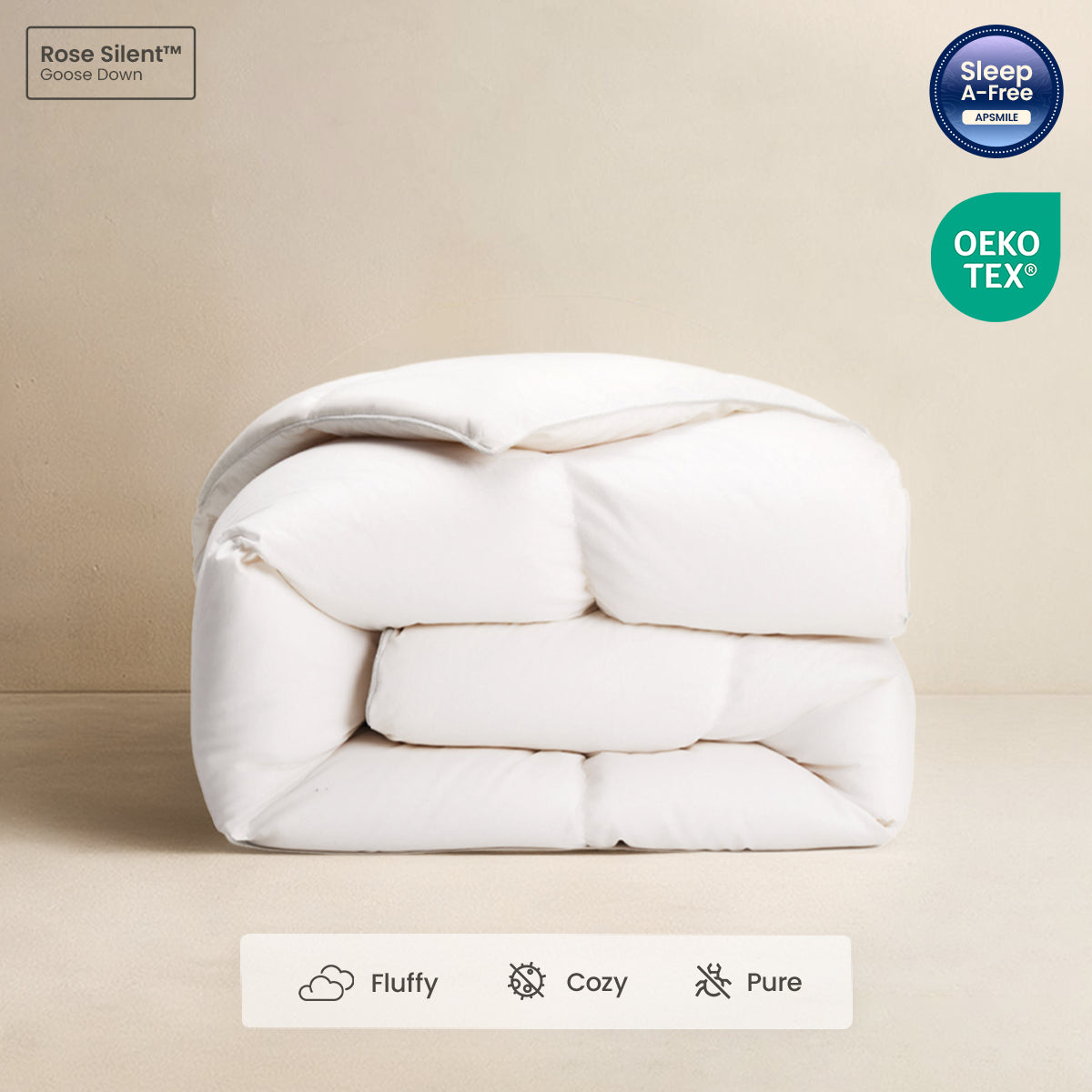
The filling formula is scientifically blended, containing 50% down filaments and 25% down clusters, with a down content that meets high standards. Combined with a fill weight of 33–39 ounces (depending on size), it delivers moderate warmth—making it a true “all-season comforter” suitable for both damp cold winters in the South and heated rooms in the North. What’s more, the down is certified by Downpass and OEKO-TEX 100, ensuring ethical sourcing and zero harmful substances—say goodbye to the unpleasant odors common in cheap down products. “I have allergies, and this is the first affordable comforter that doesn’t make me sneeze,” shares Michael, a verified APSMILE buyer.
Fabric & Construction: 400TC Down-Proof Fabric—No More Down Leakage Headaches
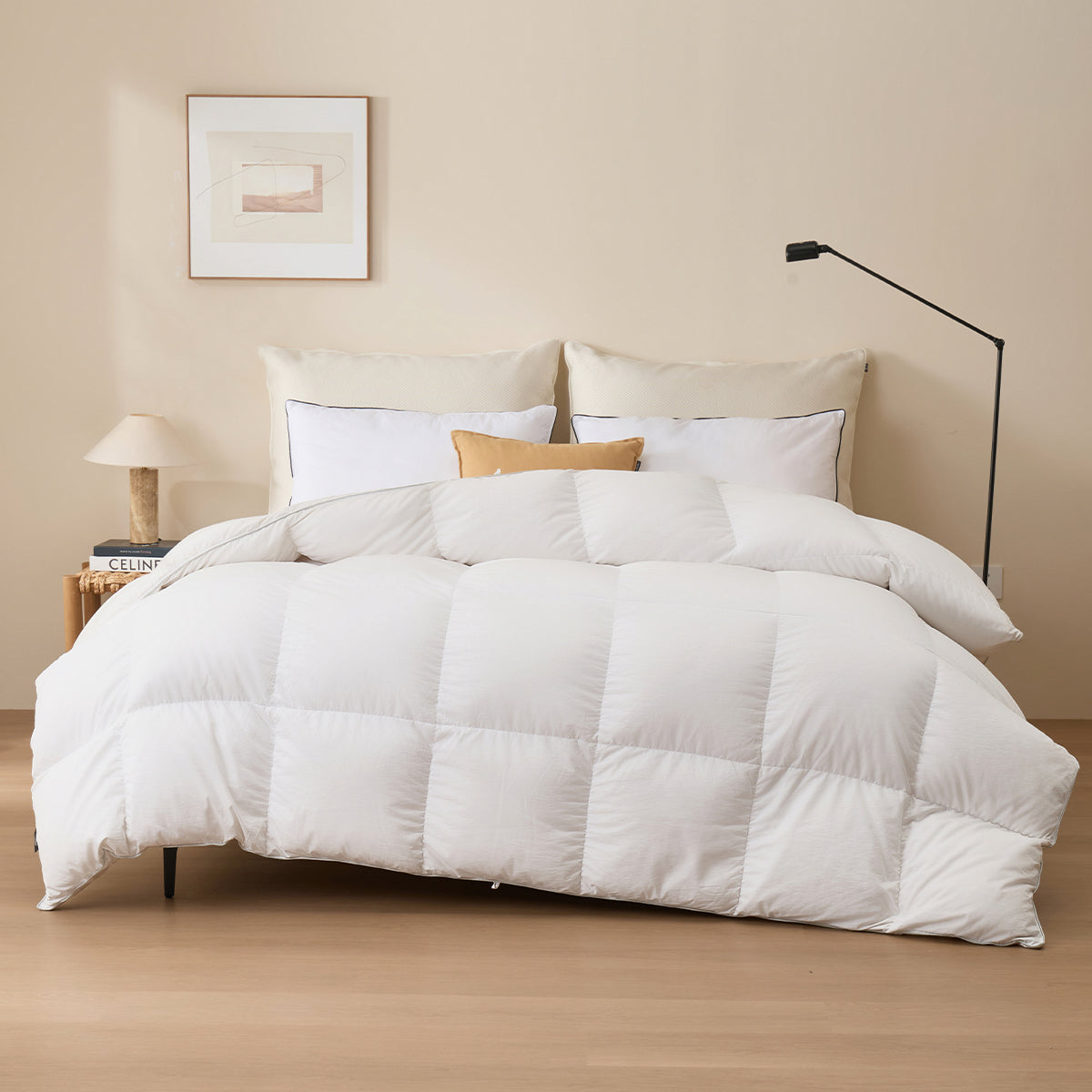
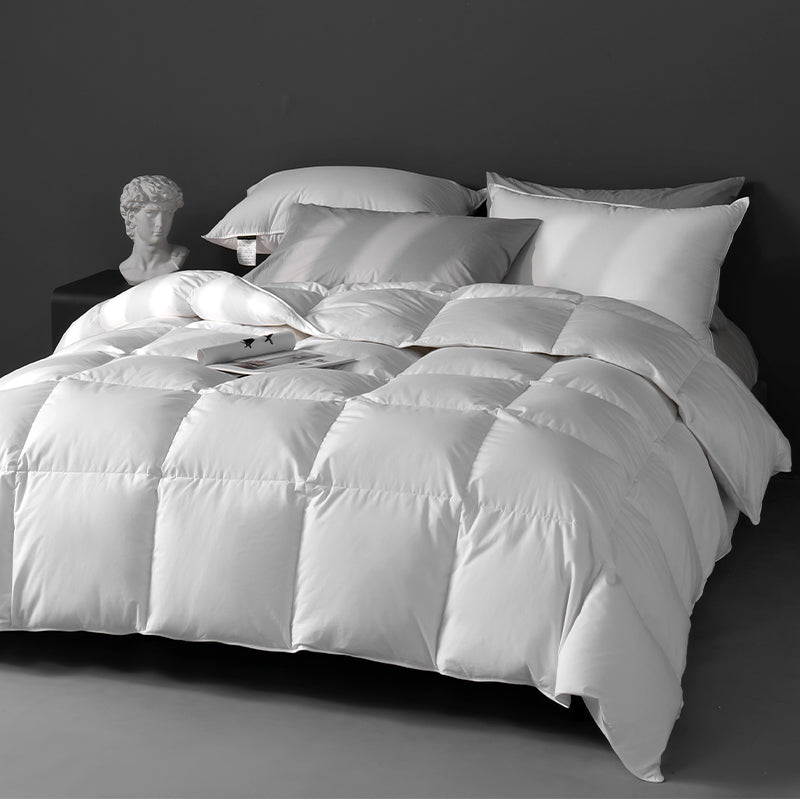
To solve the common “down leakage” problem of budget comforters, APSMILE uses a 400TC cotton-polyester blend fabric with a brushed finish. It retains the softness and breathability of cotton while boosting down-proof performance. Paired with double-needle stitching and baffle box construction, the down stays evenly distributed in each compartment—preventing shifting and cold spots.
While this construction isn’t as complex as the honeycomb design of $2,000 comforters, it improves warmth uniformity by 30% compared to regular stitched-through styles—striking the perfect balance between performance and cost. The 8 corner tabs also make it easy to pair with a duvet cover, eliminating the hassle of the comforter slipping around inside.
Easy Care: Machine-Washable Design—Lower Life Cycle Costs
APSMILE makes “easy care” a core selling point—because great bedding shouldn’t be high-maintenance. Its comforters support both machine washing and dry cleaning—no need for professional care like high-end models, and no clumping after washing like cheap alternatives. This design comes straight from its 36 years of experience making hotel linens, where durability and convenience are non-negotiable. Just machine-wash on a gentle cycle, tumble dry low, and the comforter bounces back to its fluffy state—with a lifespan of over 5 years, its annual depreciation cost is far lower than cheap comforters that need frequent replacement. It’s the kind of bedding you’ll recommend to friends, not just buy for yourself.
User Reviews: 9.6/10 for Value—Quality Shines in the Details
In user reviews, APSMILE’s “light, soft feel” and “no noise” are consistently praised. The silky 400TC fabric reduces friction sounds when you toss and turn—solving the annoying “crinkling” issue of some pricey down comforters. It scores an average of 8.73/10 among similar products, with an impressive 9.6/10 for value for money. Many users comment that “its warmth is just as good as the $1,000 comforter I used to own”. The included storage bag also makes everyday storage a breeze without compromising loft—small details that show the brand’s thoughtfulness.

Final Thoughts: When Buying a Down Comforter, Don’t Pay for “Numbers”
The difference between a $200 and a $2,000 down comforter ultimately comes down to “needs matching”. $2,000 high-end models are perfect for users chasing ultimate lightweight warmth and brand prestige. But for most people, a value-for-money option like APSMILE is the smarter choice. It doesn’t chase the gimmick of 900+ FP or hype up “Alpine goose down” origin stories. Instead, it uses 750FP golden loft, 400TC down-proof fabric, and a machine-washable design to deliver core value that’s “just right, durable, and user-friendly”.
The golden rule for buying a down comforter is never “the more expensive, the better”—it’s “perfectly matched to your needs”. Focusing on the combination of FP and fill weight, checking the fabric’s thread count and down-proof certifications, and considering whether it fits your care habits are far more important than obsessing over the price tag. APSMILE proves that you don’t need to spend a fortune to get a great night’s sleep. Right now, new customers can get a free premium storage bag with purchase—another small touch that shows APSMILE cares as much about your experience as your wallet. After all, good sleep isn’t measured in dollars—it’s measured in the warmth and comfort of every night, and APSMILE delivers that, no strings attached.
Whether you’re furnishing a guest room, upgrading your main bed, or looking for a practical gift, APSMILE’s balance of quality and value is hard to beat. Ready to stop overpaying for down comforters? Check out APSMILE’s official store today—with a 30-night trial, you can test its softness and warmth risk-free. Your bed (and your bank account) will thank you.